|
The three little stories on this page are amazing, but true. They provide a powerful insight into sports that has enabled many athletes and teams to suddenly bust loose into dramatic achievements they never dreamed possible before. Read these stories, and use the insight for yourself.  THE STORY OF THE ELEPHANT Wrapped around the leg of the little baby elephant will be a great big chain; but wrapped around the leg of the huge adult elephant will be a little flimsy rope. The elephant trainer will tell you that after a few months of straining against a big chain, the baby elephant will finally give up. After that, the trainer can replace the big strong chain with a weak little rope, and the elephant never knows the difference. Even thought he adult elephant could snap the rope with one might tug of his foot, he never even tries. Why? Because the longs months of struggling against the chain have conditioned and convinced him to believe that it's impossible!  THE STORY OF THE FLEA If you've ever had the chance to see "trained" fleas, you know that somehow the trainer has taught these little bugs to stay within a very small area on an open tabletop, and to limit their jumps to only two or three inches in height. The fleas could easily jump three or four feet off the table and get away . . . but they seldom do. That's because the trainer has kept them locked up in a small box with a three-inch ceiling. Every time the fleas would try to jump out of the box, they would crash into the ceiling three inches above. Soon the fleas become trained, just like the elephants. They begin to believe that two or three inches is as high as they can ever possibly jump. And from then on, even when the trainer removes them from the box, the fleas will never try to jump any higher. 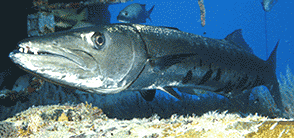 THE STORY OF THE BARRACUDA |
|
In an experiment, scientists put a big barracuda and a little mackerel together in the same fish tank. The barracuda immediately swam over and ate the mackerel for dinner. Then the scientists put another mackerel in the tank -- only this time they put a clear plastic divider between the mackerel and the barracuda. Now, every time the barracuda tried to swim over to the mackerel, he would only bump his nose against the invisible plastic shield. For two days the frustrated barracuda tried and failed to get to the mackerel. Finally, desperate, confused and hungry, he gave up. At that point, the scientists removed the shield, leaving the barracuda a clear path to the frightened mackerel. But the barracuda knew better. He knew from experience that it was "impossible" for him to swim to the other side. Imagine the poor barracuda's surprise when the scientists cropped a second barracuda in the water which immediately swam over and gulped down the tasty mackerel! For instance, if we do poorly at a sport when we're very young, we sometimes give up on that sport completely, thinking that we're bound to continue doing poorly, even when we're older. If people tell us over and over that we're too small, too slow or too clumsy to play a certain sport, we may eventually believe it . . . and act like it. If we believe the newspapers when the say that our team is a 21-point underdog, we just might live up to that prediction and lose the game. If girls accept the opinion that they can't do well in a certain sport -- sure enough, they might not even try. If the record books ever convince us that human beings just can't run any faster, jump any higher, or swim any farther . . . then we will never again be able to break the records. Like the elephant, if we don't believe we can break the rope, we won't. Like the flea, if we don't believe we can jump any higher, we won't. Like the barracuda, if we don't believe we can swim to the other side, we won't. Athletes suddenly bust loose when they realize that many of their former limitations were imaginary or self-imposed. How about you or your team? Have you been accepting someone else's "expert opinion" about your own athletic abilities? IS there a flimsy rope, an imaginary ceiling or an invisible shield standing between you and your goals? If so, busting loose might be easier than you think. A little belief goes a long long way. 
|